



Preparation • reflection • support
Psychedelic Integration Therapy in Calgary
Make space to understand your experience and decide what you want to carry forward. In-person and online appointments available.
Preparation • reflection • support
Psychedelic Integration Therapy in Calgary
Make space to understand your experience and decide what you want to carry forward.
In-person and online appointments available.
Psychedelic Preparation & Integration
With Charmaine Husman, DKATI, RTC, CT
I’m a Registered Canadian Art Therapist, somatic counsellor and clinical supervisor working in psychedelic preparation and integration since 2013. I support people in exploring experiences that may feel meaningful, confusing, unsettling or difficult to explain, using a trauma-informed approach that respects their beliefs and choices.
Alongside my clinical practice, I’m an author and educator who has developed and taught approaches to psychedelic preparation and integration since 2018. My work brings together art therapy, bodily awareness and reflection. I offer ways to explore your experience while trusting that your understanding may develop over time.
My professional work also includes involvement with TheraPsil.
Support After a Psychedelic or Non-Ordinary Experience
You might return from an experience with a new perspective but little sense of how it fits into your daily life. Perhaps something difficult surfaced, or you’re feeling anxious, emotionally unsettled or disconnected from the people around you. An experience can also feel deeply positive and still leave you with questions.
Psychedelic integration is the process of exploring what happened, how it has affected you and what you want to do with it. Our work can include emotions, imagery, bodily sensations, changes in your beliefs or concerns about relationships and identity. You don’t need a clear interpretation before seeking support.
I also work with people reflecting on non-ordinary experiences associated with breathwork, meditation or spiritual exploration. My clinical services focus on preparation, integration and harm reduction. I do not supply or administer psychedelic substances during therapy sessions.
What Happens in a Psychedelic Integration Session?
We begin with what feels most important now. That might be a question you can’t stop thinking about, an emotion that has stayed with you or difficulty returning to familiar routines. There is no expectation to recount the entire experience or find a positive meaning in every part of it.
Working together

Understanding How the Experience Is Affecting You
I’ll invite you to share what brought you to integration and how you’ve been feeling since the experience. We can discuss what has changed, what feels unresolved and who you can turn to for support.
If you’re feeling unsettled, we may begin with what would help you feel more supported in your day before exploring the experience in depth. We’ll decide together what feels useful to approach and what can wait.

Exploring Images, Emotions and Bodily Sensations
Some experiences are difficult to describe in a straightforward narrative. I may invite you to work with art, reflective writing or bodily awareness so we have different ways to approach what you remember and feel.
An image can give us something tangible to reflect on without requiring an immediate explanation. We explore your associations together, allowing for uncertainty and more than one possible understanding.

Bringing the Session to a Close
Before we finish, we make time to reflect on what stood out and how you’re feeling. We can discuss what you would like to return to, whether further reflection would be helpful and what support you may need between appointments.
If we’ve created artwork, we’ll also consider what you want to do with it. You might keep a supportive image somewhere visible or put more emotionally charged work away until you’re ready to revisit it.

Preparing for a Psychedelic Experience
Preparation and harm reduction
Preparation gives us time to explore what you’re hoping for, what concerns you and what support you may need. It also makes room for uncertainty, including deciding whether to proceed. This counselling work does not establish medical suitability or guarantee a safe experience.
My approach draws on trauma-informed art therapy and somatic counselling. We focus on understanding your needs and identifying resources you can draw on, with attention to the time before and after the experience.
-
We can discuss what you hope to understand or change, what has influenced your decision and whether you feel pressure to have a particular experience. This includes making room for concerns or hesitation, alongside curiosity and hope.
-
I often invite people to explore how they experience strength or well-being and create a visual representation of it. We can use that as a personal resource in our work together. We also consider who you can turn to and what support you may want afterwards.
-
We can identify questions you want to ask a provider or facilitator and discuss your boundaries and expectations of care. This includes considering how you would communicate discomfort, ask for support or express a preference.
Questions about health risks, medication interactions and whether psychedelics are medically appropriate for you need to be discussed with a qualified healthcare professional. My role is to support your reflection and help you identify what you need clarified.
-
We can think ahead about returning to your responsibilities, relationships and familiar surroundings. What time will you have to reflect? Who could you speak with? Planning for the period afterwards gives you somewhere to bring questions or difficulties that may emerge later.
"I am happy to see the depth and scope of the wisdom presented and the link with art therapy and the topic of psychedelics.”
Charmaine provides a very common sense, grounded, and WISE approach. Art therapy professionals need competencies to assist clients and the medical profession who are turning to psychedelics for healing. It is a tool for healing.
- Jan Grygier
"Thank you so much, this class is opening my mind to so many new possibilities, very grateful.”
A big takeaway for me is the level of professionalism here. It is really reassuring to me to have a space that can be rigorous and open, scientific and artful, just feeling very balanced in many ways and allowing us to think for ourselves and experiment . It just feels very hopeful to me to find a space that feels so open and beautiful and still contained and academic.
- Heidi
“The learnings and art directives extend my expectations, the offerings can be applied to so many other ways other than psychedelic journeying. “
Thank you for your heartfelt offerings. I really enjoyed the content and wisdom you shared with us.
- Anna Schwank
Working Through Difficult Experiences and Lasting Questions
Integration can involve both appreciation and discomfort. There may be something you want to preserve, something you wish had happened differently or parts of the experience you still don’t understand. We can make room for those differences without forcing them into one explanation.
Integration in everyday life

Anxiety, Fear or Distress After an Experience
A frightening or overwhelming experience may leave you unsure what to make of it. You might feel embarrassed to discuss it, especially if others describe similar experiences as entirely positive. In our work, you can speak about what was difficult without being expected to frame it as a breakthrough.
We focus on how you’re doing now, what feels manageable to explore and whether additional care is needed.
Changes in Identity, Beliefs or Relationships
An experience may raise questions about who you are, what you believe or how you relate to other people. I welcome spiritual and transpersonal perspectives when they are meaningful to you, while also making space for doubt and different interpretations.
Together, we can consider how these questions affect your choices and relationships. You don’t need to adopt a particular worldview to work with me

Disappointment or the Urge to Repeat an Experience
You may have hoped for relief or clarity that didn’t arrive or felt a connection that now seems difficult to access. We can explore that disappointment and what you’re hoping another experience might provide.
My harm-reduction approach includes giving attention to the wish to return repeatedly to an intense state. We can examine what you’re seeking and how support, connection or change might also develop in everyday life.
Turning Meaning Into Everyday Action
An insight can feel significant without telling you what to do next. We can explore what it means in practical terms, such as having a conversation, making space for creativity or reconsidering how you spend your time.
There is also room to slow down before making major decisions. Something that felt urgent immediately afterwards may look different with reflection. We consider your circumstances and responsibilities as you decide what changes you want to make.
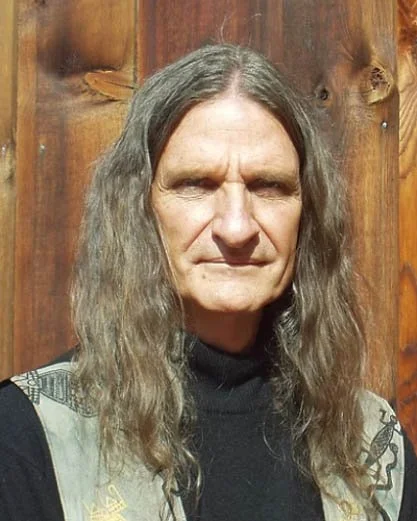
“The demand for the various plant medicines of our earth and psychedelic healing medicines appears to be in great need these days”
And, the need for a full integration during and/or after the experience doesn't seem to be happening with any regularity. Thus, I am grateful and relieved at the comprehensive integration being offered by Charmaine Husum and the integrity with which she offers this.
- Duncan Grady (Indigenous Elder, Kootenays, BC)
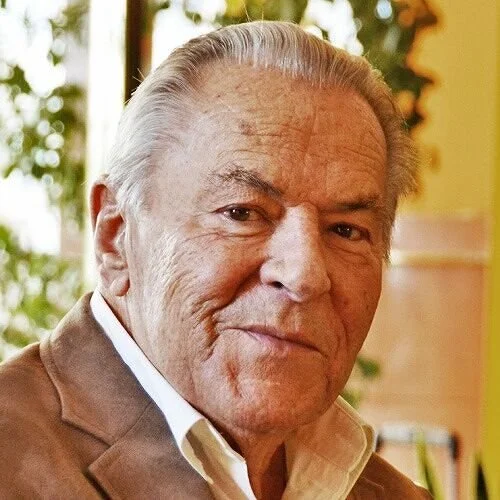
“The book of Charmaine Husum is a valuable contribution to the important subject of integration and healing by building a bridge between the work with psychedelics and art therapy.”
Her book on psychedelics and art therapy can offer important guidelines for the work of therapists and for anybody who wishes to use art therapy as an instrument to deepen the integration of psychedelic experiences.
- Stanislav Grof, MD, PhD (author of The Way of the Psychonaut)
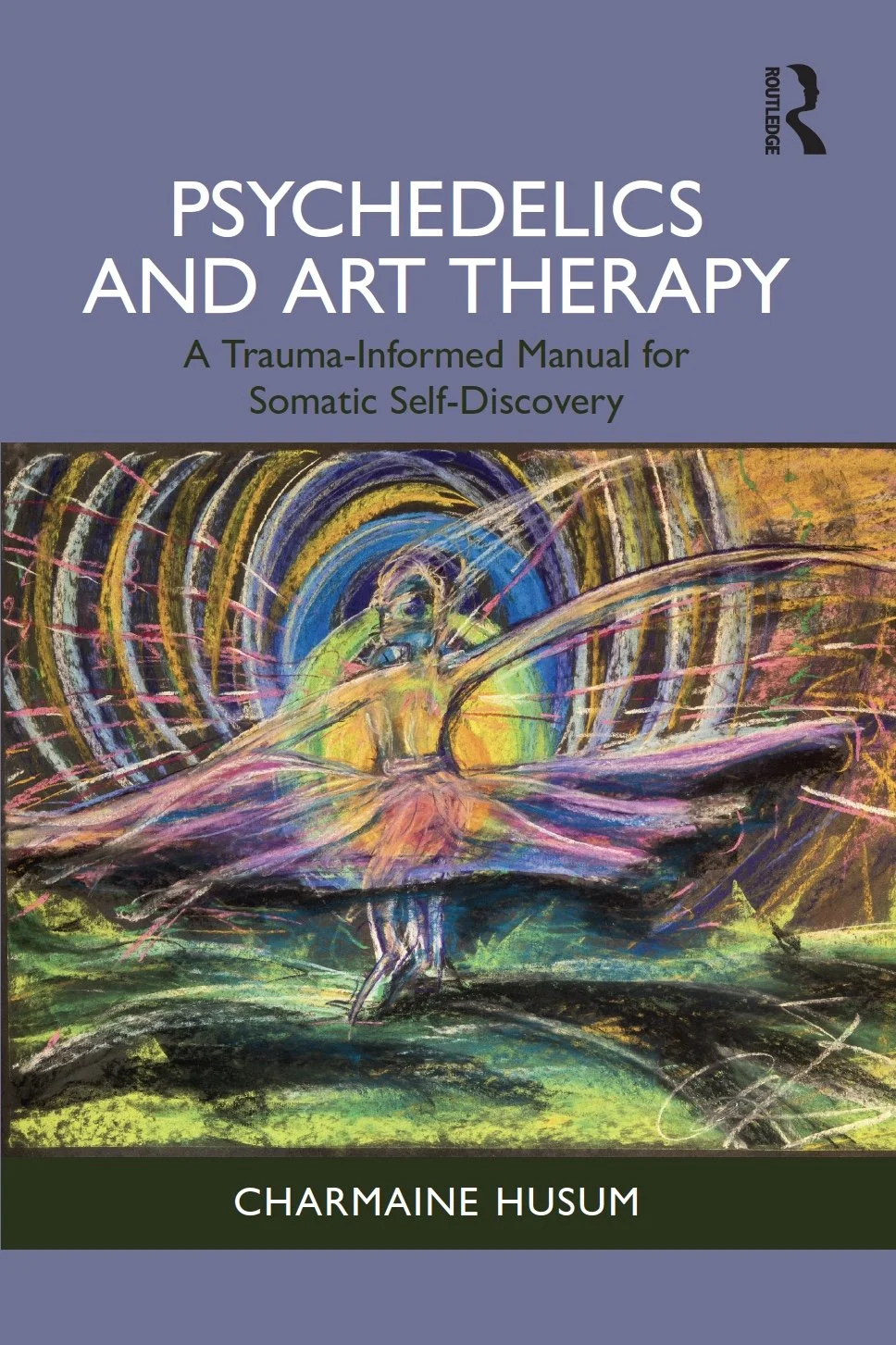
Art Therapy, Somatic Practice and Psychedelic Integration
I teach through the Kutenai Art Therapy Institute and TheraPsil, exploring how art therapy can support preparation, integration and trauma-informed care. My clinical work and teaching both make room for experiences that are visual, physical, symbolic or difficult to put into words.
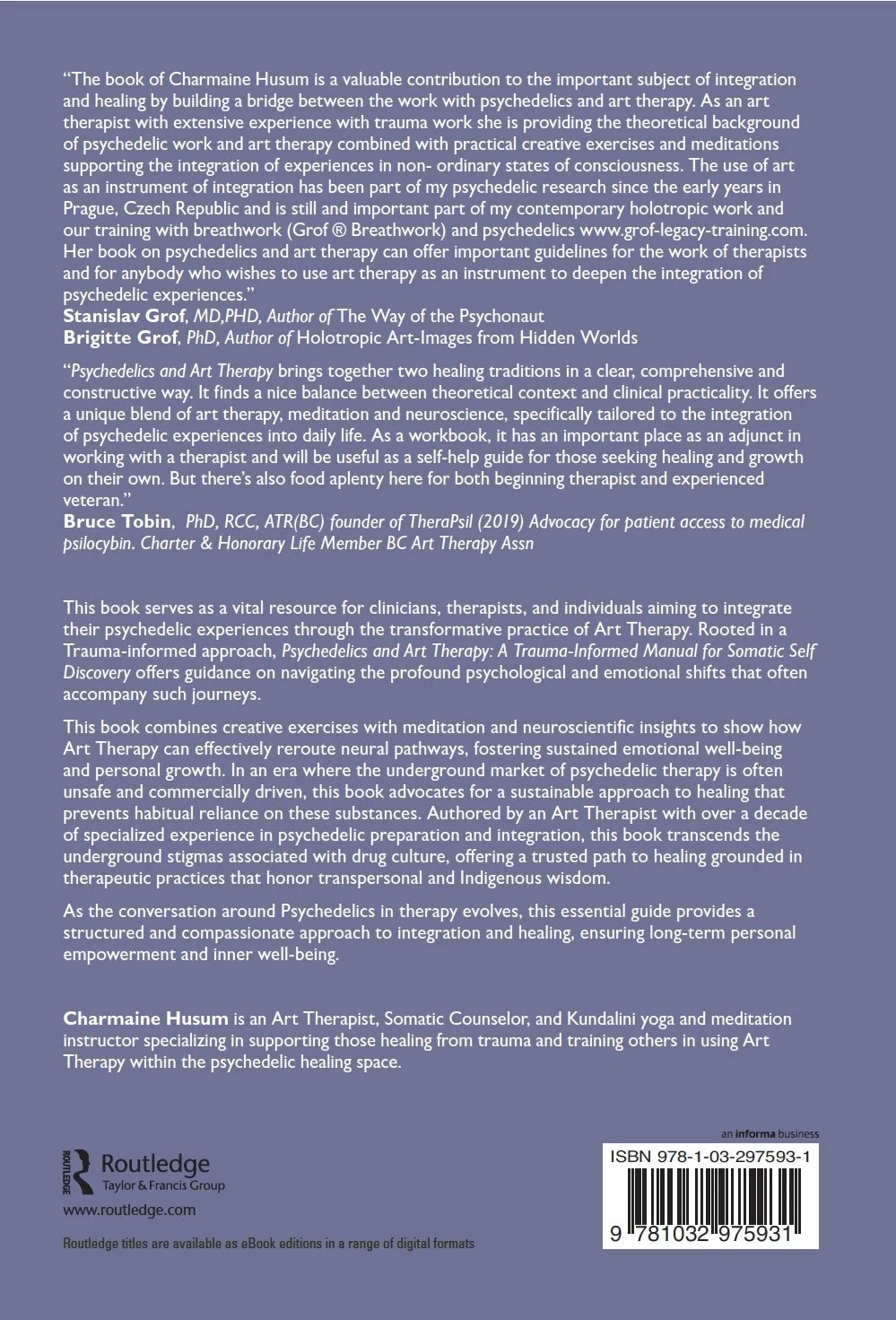
My book, Psychedelics and Art Therapy: A Trauma-Informed Manual for Somatic Self-Discovery (Routledge, 2025), brings these approaches together through creative exercises and reflection. It received a joint endorsement from Stanislav and Brigitte Grof and offers a resource for people interested in exploring this work further.
Questions About Psychedelic Integration
-
No. These sessions provide counselling for preparation and integration. I do not administer or supply psychedelics, and the appointments are not sessions for taking substances. We focus on your questions, experiences and ongoing support.
-
Yes. You can contact me about a difficult or frightening experience, including one you’re unsure how to explain. We can discuss how it is affecting you and whether my services are an appropriate fit. Severe or worsening symptoms need prompt medical assessment rather than waiting for a discovery call.
-
You can seek support for a recent experience or one from further in the past. Sometimes questions become clearer over time, or an earlier experience takes on new significance. We can begin with what is relevant to you now.
-
Integration offers space to reflect on a meaningful experience and consider how it connects with your values, relationships and daily choices. You don’t need to be distressed to seek support.
-
I’ll help you explore it, but I won’t assign a fixed meaning to your images, memories or spiritual experiences. We can consider different possibilities and how they relate to your life without needing to settle every question.
-
No. I can introduce approaches as they become relevant, and we’ll discuss what interests you. Conversation is part of our work, and creative or contemplative practices are offered as options.
-
Yes. I offer psychedelic preparation and integration counselling online and in person in Calgary. A discovery call gives us an opportunity to discuss your needs and the practical arrangements for working together.
-
Yes. You may have experienced a sense of presence, connection with ancestors, angels or beings you describe as entities or aliens. Perhaps it felt comforting, frightening or difficult to explain, and you’re unsure how someone else will respond.
You’re welcome to discuss those experiences with me. We can explore what you experienced, what it means to you and how it is affecting your life, without needing to agree on a single explanation. I bring openness and a grounded clinical approach, with attention to your well-being and the support you need.

Find Support With Psychedelic Integration Therapy
You may be carrying questions, difficult feelings or a sense that something important deserves more attention. Let’s talk about your experience and how I can support you in moving forward.